Can something profoundly tragic, and seemingly impossible to address, also be very funny?
Yes. Of course it can.
Especially when the tragedy is our current race at full speed towards climate disaster. The absurdity and paradoxes of the situation lend itself so real comical observations, like how sustainability professionals are absolutely terrified of the consequences of the climate crisis, and yet so dissonant when it comes to changing lifestyle, including eating meat, flying across the planet and so on.
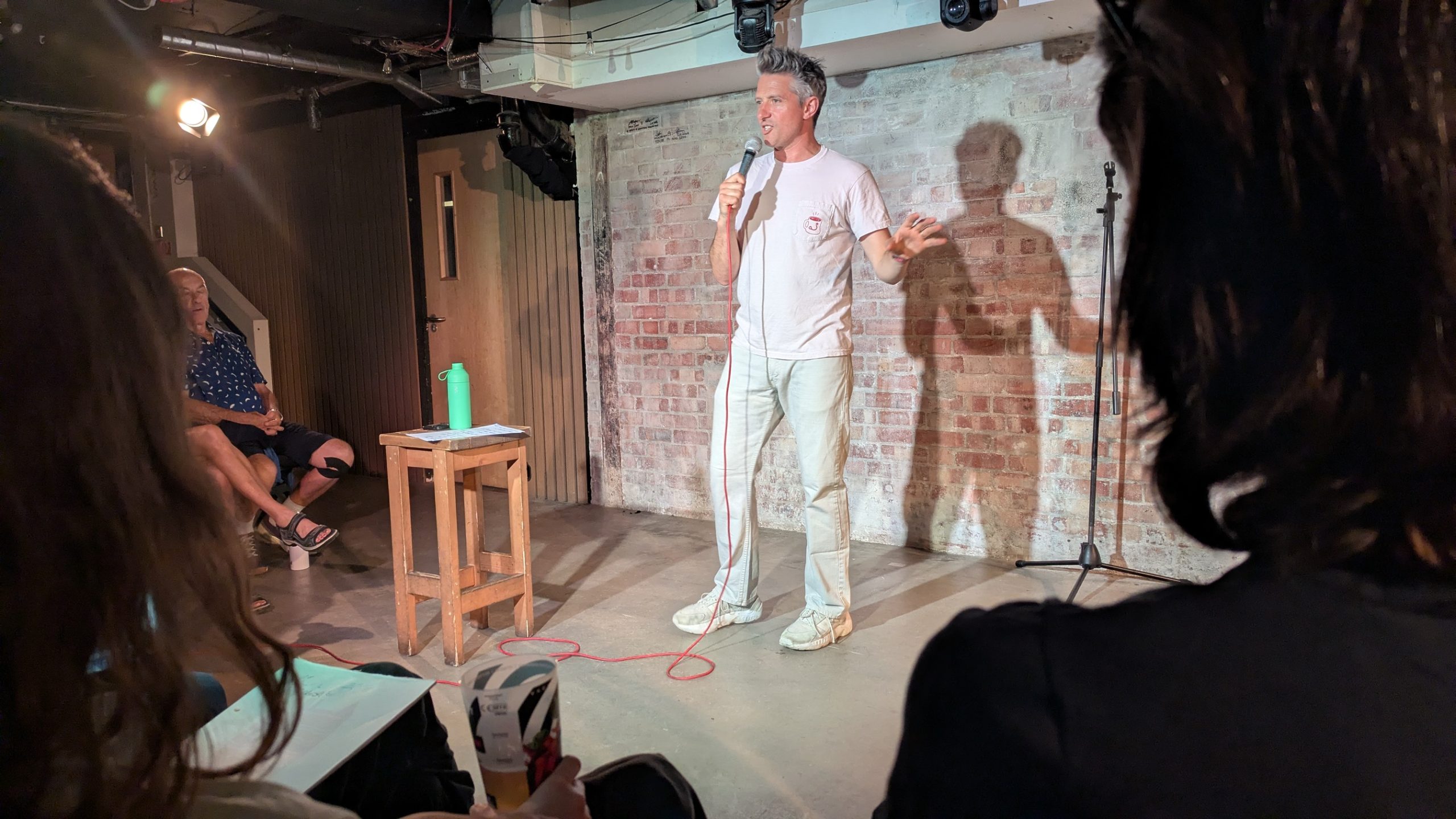
Last week I went to see the work-in-progress show “Canary” by climate comedian Stuart Goldsmith.
Shouldn’t we cry and scream that our house is on fire??
Shouldn’t we mourn the tragedy that is unfolding in front of our very eyes and warn people of the dire consequences of the collapsing climate ecosystems?
I decided that, after having been shaken by the People Emergency Briefing and feeling terrible for days as a consequence, I wanted to have this completely different experience to reflect upon the situation.
And I loved it.
Comedy comes from observing relatable behaviours in detail and offering them back to the audience so they can see themselves.
But making fun of something that causes millions of deaths every year? Isn’t that outrageous?
Thinking about it, since the Ancient Greeks, tragedy and comedy have been blended to try and represent the complexity of the human soul with more compelling stories.
This show has a lot of that.
There is even a part (slight spoiler alert) in which the audience can share their climate confessions to feel better about themselves: because we all sin, holy father.
Interestingly, what I thought was a big personal failure (having cheese on my pizza instead of adhering strictly to my standard plant-based diet) was laughed off as something a bit ridiculous, like a child who robs sweets from the cupboard (note to self: next time, if you don’t want to be picked on during a show, don’t seat at the front and, most importantly, don’t raise your hand).
So here are my takeaways from this experience:
No, we don’t need to cry to take the issues seriously. We can do that while laughing together about our shared experiences and fallacies. In fact, this can raise awareness and point the spotlight on them, so we can do something about it.
Alarmism does not always equal action; in fact, quite the opposite. It can get people to feel disempowered and freeze them into inaction. Not the case with the People Emergency Briefing for me, but nearly… People need to know what their next meaningful step can be, not just to be terrified by the current situation.
Often, we are doing a lot as individuals, but we just don’t see it because we want, single-handedly, to solve the climate crisis, which is obviously impossible. Often our contribution seems negligible, making us feel like we are not doing enough. But it is when we put in our best effort together with others that results start piling up and showing up over time.
We need to build our resilience: not just in our cities’ infrastructures, but also our personal resilience, so that we can come together, respond positively to the challenges and have the energy and motivation to keep going. Constant alarms shoot cortisol down our veins and can be seriously harmful for our overall health, making our work as sustainability leaders particularly difficult and us prone to burnout. Laughter can be a wonderful way to develop resilience, lower cortisol, and bring us closer to our fellow humans.
What is your take on this?
What’s your preferred way to talk about the climate crisis?
Frustrated because you cannot make an impact?
I have observed a lot of burnout in my work as a sustainability coach, so I developed a leadership development programme and community that supports you by building up your resilience, finding your community and learning how to become more influential when you want to get buy-in for your initiatives. I’m hosting a free masterclass on the 14th of July in which I share my step-by-step blueprint of how to get the buy-in from any audience, while avoiding burnout. You can book your free seat here: https://thegreengorilla.co.uk/masterclass/ (Note that the session will not be recorded so come and join us live!)
Last week, my sister sent me an Instagram post in which an uber-clever creator shared the headline from a media outlet and added his own spin to it:
“London, conference on extreme heat cancelled due to extreme heat.
Soon we will have:
Conference for asocial individuals cancelled because they didn’t want to meet people
Conference for indecisive people cancelled… or maybe not
Conference of mothers cancelled because I said so!
…”
I’m all for making the climate crisis a topic to be talked about, and even joked about. I’m a big fan of climate comedy.
But this time, I didn’t laugh.
It felt way too real.
Emergency or not emergency?
Last week I attended a couple of events organised as part of London Climate Week. This is an annual cluster of events run in the capital to raise awareness of the state of the climate and the actions needed to address our current challenges.
The day I went, London’s temperature broke the record as the highest ever recorded in June: 36 degrees C.
As I was sweating through every layer I was wearing, walking under the blazing sun, I felt relief entering the Barbican cinema theatre to watch the People’s Emergency Briefing: Chris Peckham’s short film based on the National Emergency Briefing delivered in Westminster to national decision-makers in November 2025. You you want to watch it, you can find a public screening on their website.
The relief lasted for about 15 minutes. Then the film started.
Even though I have been working in sustainability for two decades, I squirmed in my seat throughout the show, feeling deeply uncomfortable, bombarded by the terrible news about the state of the current climate and related consequences for 50 minutes.
At the end, we had just enough “but we can still do something to change the catastrophe we are heading towards at full speed” not to make us want to disappear immediately six feet under.
A cocktail of shame, guilt, fear, and helplessness was on everyone’s face. Some people left before the post-film debate started. Maybe they didn’t feel as bad as I did and wanted to move on with their lives or felt that that was more than enough information for a single day.
Pair this incredibly sombering viewing with the hottest temperature of the year, and it’s very hard to keep being stubbornly optimistic, as I always suggest you do.
And that’s the point of this article.
What do strong expressions like “emergency”, “crisis” or “hottest on record” do to your nervous system?
Do they make you want to do something now?
Do they make you lose the will to live?
Or do they make you book your next holiday to the Maldives because “f*ck it, we are doomed anyway”?
Language is a complex beast when it comes to persuasion and behavioural change, and I don’t think we have cracked it completely.
Some people respond to just information: this is the state we are in. You need to change. And they do.
Most people, though, need more emotional messages to change: shock, fear, or even positive emotions, like love, compassion, pride, but especially hope, which is some form of reassurance that their actions and contributions will count for something.
In the case of climate, most frightened people convey frightening messages, and most ordinary people have enough on their plate (keeping their families going, putting bread on the table and so on), that worrying about something that looks so scary and impossible to solve is not on their radar. So they just switch off.
Most messaging around the climate is frightening indeed, because that’s the reality: it’s genuinely bad, we are running out of time, and we need to do something about it.
However, you wouldn’t want the fire alarm to be blaring all the time, because people, instead of trying to put out the fire, would either run away, react angrily, or stop listening to it altogether.
Likewise, you need to tailor the language you use in your climate messaging to avoid one of the following responses:
fight (rioting in the street, fighting for food in supermarkets, escalating violence),
flight (escape to a different reality, endlessly scrolling social media, booking a flight to forget the problems exist)
freeze (do absolutely nothing and carry on business-as-usual style).
Strong, emergency language with no actionable steps generates in most people those instinctive, reptile reactions our brains activate to protect us from harm.
I prefer to opt for a different approach: active hope.
Active Hope: what it is and how to practise it
Active hope is more sophisticated but has the advantage of being gentler on the nervous system and guides people to positive actions, instead of depression, numbness or hysteria.
It was first devised as a four-step reiterating “work that reconnects” by Joanna Macy and Chris Johnstone (read more here):
Coming from Gratitude.
Honouring Our Pain for the World
Seeing with New Eyes
Going Forth.
Let’s look at them one by one.
Coming from Gratitude
Developing our sense of wonder and appreciation for what we do have, before we grieve for what we don’t is profoundly strengthening.
Research indicates that gratitude can lower the risk of depression, enhance physical health and even prolong our lives.
Focusing your attention on what you are thankful for in everyday life can bring up a more positive attitude towards life in general, especially if you make it a regular practice.
I keep a pebble in my coat’s pocket so that every time I put a hand in my pocket, I remember to be grateful for what I have in my life.
To this practice I would add some form of meditative practice, either formal sitting down and meditating, or something else that has similar effects, like breathwork, or even repetitive sport practices (e.g. swimming, running, walking, yoga, etc.) and hobbies (e.g. singing, knitting, crocheting, drawing, dancing, etc.).
Together they will help regulate your nervous system, ready for the next steps.
Honouring Our Pain for the World
When I was watching that film last week, I made sure I breathed deeply during the most upsetting parts. I imagined taking it all in, and breathing it out through my heart (a practice described in the Active Hope book). If you keep the pain inside, it can annihilate you. It’s important to acknowledge the pain in the world, then gently let it go, so that you are aware, you feel it, but it doesn’t make you flee, fight, or freeze.
Seeing with New Eyes
This stage is about seeing ourselves as a part of the wider ecosystem, much wider than your physical reality and your timeline, and about seeing and encouraging interconnections instead of individualism. Fostering co-creation with others in conversations, projects, every day activities.
On our own we can feel lost and insignificant, with others we can make a difference and support each other. I love the example that the book offers of a picture in a newspaper: if you look at it under a microscope, you can see its made of thousands of little dots that, on their own, don’t seem to do much, but action is often invisible at the level at which the action is taken.
Seeing with new eyes means alsochoosing to answer our calls to action, drawing from our individual strengths and recognising other people’s strengths, choosing to respond with courage, determination and creativity every day.
On this last quality, I’d like to add that action is not necessarely “just” protesting in front of Parliament, or on the streets.
Activism can also be quiet and behind the scenes, and I would invite you to find your own way to act, one that feels aligned with your strengths, values and personality.
For instance, after the film, I decided to start a craftivism movement where I live. I am creative by nature, and I love the idea of creating something beautiful that has the potential to generate deep insights and feelings in our MP and other people of power, more than a letter or email would.
Going Forth
In this step, we look at the inspiring vision, we seek ways to paint it vividly in our collective imagination, so that we keep our eyes on the target.
It’s also about supporting others and receiving support, and looking after our energy and resilience so that we can keep going.
So, I don’t regret watching the People’s Emergency Briefing. On the opposite, it wasn’t easy viewing, but it was necessary, and I would invite you to watch it too. However, make sure you let it go through you, and that you channel that new awareness into meaningful, aligned action.
And if you have already watched it, I’d love to know what you thought of it.